Friday, February 29, 2008

MARKET SNAPSHOT: U.S. Stocks Close Sharply Lower To End With Monthly Declines

February 29, 2008: 05:04 PM EST CNN

U.S. stocks plunged on Friday, ending the week and the month on a losing note after losses by American International Group Inc. shook up Wall Street and poor results from Dell Inc. rocked the tech sector.

"We had a trainload of bad news; they couldn't keep the bad news coming fast enough," said Art Hogan, chief market strategist at Jefferies & Co.

The Dow Jones Industrial Average (DJI) fell 315.79 points to 12,266.39, giving the blue-chip gauge a weekly loss of 0.9%. The Dow fell 3% in February, and is down 7.5% for the year to date.

All of the Dow's 30 components spent the final day of February in the red. Pacing the action was AIG (AIG), off more than 7% after the insurance giant reported the largest loss in its almost 90 years in business. .

"It will be interesting to see what happens next week, since we're in for the same combination of bad economic data and bad corporate news -- that's what happens when you have an economic slowdown," Hogan said.

Other financial stocks were hit as well, with shares of Ambac Inc. (ABK) down 5.6% on reports that a plan to provide the firm with new capital has hit a snag.

Outside the Dow industrials, Dell Inc. (DELL) fell 4.7% after the PC maker reported fourth-quarter profits fell 6% from a year ago.

The S&P 500 (SPX) dropped 37.05 points to 1,330.63, down 1.7% for the week; 3.5% for the month and 9.4% year-to-date.

The technology-heavy Nasdaq Composite (RIXF) declined 60.99 points to 2, 271.48, a drop of 1.4% on the week; a 5% decline for February and 14% so far this year.

Volume on the New York Stock Exchange topped 1.7 billion, with nearly seven stocks posting losses for each share on the rise. On the Nasdaq, nearly 1.2 billion shares traded hands, with decliners stocks topping those advancing more than 4 to 1.

Sector snap

Often isolated from the carnage of late, the tech sector joined the suffering this time, with declines coming from bellwethers including Hewlett-Packard Co. ( HPQ) and IBM Corp. (IBM). .

Retail stocks also slipped amid gloomy news on consumer spending, with the S&P Retail Index (RLX) off about 3.3%. .

Gold futures finished with gains, having hit a record high of $978.50 an ounce overnight, as the metal continues to draw support from weakness in the U.S. dollar and rising investment flows into commodities. Gold for April delivery ended up $7.50 at $975 an ounce on the New York Mercantile Exchange. Gold posted a weekly gain of $27.20 from last Friday's closing level of $947.80. .

Elsewhere on the Nymex, crude-oil futures hit a record high of $103.05 overnight before trimming gains to end at $101.84 a barrel. .

The dollar pared its losses after dropping to three-year lows against the yen, with the greenback buying 103.79 yen after an earlier fall as low as 103.81 yen -- the first time the pair fell below the 104 level since March 2005 -- compared with 105.33 yen in late U.S. trade Thursday. .

Downbeat data

The stock indexes steepened their losses on a decline in consumer sentiment in February, with more households reporting financial distress than anytime since the worst of the 1991 recession. .

The sentiment data coincided with a survey of manufacturing and sector activity in the Chicago area, which fell to 44.5 in February, "indicating a contraction in the economy in the region," said Drew Matus, a Lehman Bros. economist.

The Commerce Department reported consumer spending climbed more than predicted in January, with the 0.4% hike in buying illustrating an increase in costs that is denting Americans' purchasing power. .

"Today's data on personal spending showed a fairly good gain of 0.4%, but the gain was eaten up fully by higher prices," Tony Crescenzi, a bond analyst with Miller Tabak & Co., wrote in a research note to clients.

"The Federal Reserve certainly won't be pleased with the 0.3% rise in core consumer prices in today's report, but we have seen from the Fed continued emphasis on growth risks, which for now reduces the importance of the inflation news from a monetary policy perspective," Crescenzi added.

Active issues

Friday's most active stocks included MF Global Ltd. (MF), down more than 17% in a second day of steep losses amid ongoing fallout from the broker's disclosure of a $140 million loss on unauthorized trades in wheat futures.

Shares of 3Com Corp. (COMS) ended more than 13% higher, with the networker gaining on news that work continues on securing the sale of the company to a U.S. investment firm and its Chinese partner. .

The Gap Inc. (GPS) gained almost 4%. The country's largest clothing chain reported fourth-quarter profits climbed 21%.

In overseas trading, British shares pulled lower on losses for banks and airlines. .

In Asia, stocks fell, with Japanese stocks under pressure and Australia's market hit on weakness in financials. .

Euro Keeps on Climbing Against Dollar


BERLIN (AP) -- The euro continued its rapid climb to new highs against the dollar on Friday, hitting $1.5238 in early European trading.

The dollar has been plagued by uncertainty about the course of the U.S. economy even after U.S. Federal Reserve Bank Chairman Ben Bernanke said Thursday that the American economy was not "anywhere near" the dangerous situation of the 1970s.

With the economy slowing and inflation rising, fears have grown that the country could be headed for the dreaded twin evils of stagnant growth and rising prices known as stagflation.

The euro's peak Friday was above the previous record of $1.5229 that it reached on Thursday.

In midmorning trading, the euro subsided slightly to $1.5203 from the $1.5215 it bought in late New York trading Thursday.

"The dollar looks set to finish the month with yet more downside pressure being heaped upon it," said Gary Thomson of CMC Markets in London.

The British pound fell to $1.9871 from $1.9926. The dollar dipped to 104.39 Japanese yen from 105.36 yen in New York the night before.

The euro topped $1.50 for the first time since its 1999 introduction early Wednesday, then surged above $1.51 after markets took comments from Bernanke as a sign that yet more U.S. rate cuts are on the way.

Lower interest rates can jump-start a nation's economy, but can weigh on its currency as traders transfer funds to countries where they can earn higher returns.

Toxin ricin found in Las Vegas hotel room-media

WASHINGTON (Reuters) - Ricin, a deadly poison, was discovered in a hotel room in Las Vegas but officials don't believe the incident is terrorism related, media reported on Friday.

Las Vegas police were called to an Extended Stay America Hotel on Thursday after a suspicious substance was found in one of the rooms, the reports said.

Preliminary tests indicated the substance was ricin, which can be deadly even in small quantities. Results from further tests were expected later on Friday.

Homeland Security and the FBI are investigating along with the Las Vegas police. "This event does not appear to be terrorism related," FBI spokesman Richard Kolko said in a statement.

Three police officers, three hotel employees and another person were taken to the hospital for testing and observation. All appeared to be in good condition, authorities said.

Ricin is made from castor beans and in proper doses can be used for cancer treatments. It attacks cells, preventing them from making necessary proteins, and an amount the size of a grain of salt can be deadly.

In 2003 an envelope containing ricin was sent to the White House but was intercepted by the Secret Service. Ricin also was found in a similar envelope at a South Carolina postal facility.

It also was detected in a Senate mailroom in 2004.

In 1978 dissident Bulgarian writer Georgi Markov was killed after a passerby in London jabbed him with an umbrella that injected a tiny ricin-filled pellet.

Britain: Harry's Afghan Deployment Over


LONDON (AP) -- Britain's defense chief decided Friday to immediately pull Prince Harry out of Afghanistan after news of his deployment was leaked, citing concerns that media coverage could put him and his comrades at increased risk.

Air Chief Marshal Jock Stirrup, chief of the Defense Staff, said he decided to withdraw the prince after senior commanders assessed the risks, the Defense Ministry said in a statement.

Harry, third in line to the British throne, has been serving on the front line with an army unit in Afghanistan's southern Helmand province since mid-December. He was originally due to return to Britain within weeks, but "the situation has now clearly changed," the statement said.

The ministry asked the media not to speculate on Harry's location - or how and when he would return - until he was back in Britain.

British officials had hoped to keep Prince Harry's deployment secret until he had safely returned, but they released video of him serving in Helmand province after the leak. The Australian women's magazine New Idea reported on Harry's deployment in January. The news appeared Wednesday in the U.S. Web site the Drudge Report, and media around the world subsequently reported it.

The ministry deplored the leak by "elements of the foreign media."

"However, this was a circumstance that we have always been aware of and one for which we have had contingency plans in place," the statement said.

Queen Elizabeth II said her 23-year-old grandson had performed "a good job in a very difficult climate."

Prime Minister Gordon Brown said the prince had demonstrated that he was an exemplary young officer and the country owned him a "debt of gratitude.

"Security considerations come first. That has been the deciding factor which was made by our defense staff and I think that everybody will respect that is the right decision," Brown said.

Harry is the first royal to serve in a combat zone since his uncle Prince Andrew flew helicopters during Britain's war with Argentina over the Falkland Islands in 1982.

Tours to Afghanistan usually last six months; Harry has served 10 weeks.

Harry conceded in an interview filmed last week that when he returns to Britain he could be a "top target" for Islamic terrorists.

"Once this ... comes out, every single person that supports them will be trying to slot me," he said.

But he said his deployment was a welcome chance to escape from paparazzi and hostile headlines. He said it was probably the best chance he'll ever get at being a normal person.

"To be honest with you the one nice thing is not knowing what's in the paper, what kind of rubbish people are writing," he said.

Harry, a regular in London's nightclub circuit, has made steady headlines over the years. He's been snapped wearing a Nazi uniform at a costume party, cavorting with strippers, and scuffling with the photographers outside trendy London nightspots.

His red hair coated in dust, Harry said he had been eating military rations and drinking nonalcoholic beverages.

The deployment plan had been disclosed to reporters, with no specific date, but was not reported previously because of an agreement between the Ministry of Defense and all major news organizations operating in Britain, including The Associated Press. The news blackout was intended to reduce the risk to the prince and his regiment.

Harry was supposed to go to Iraq with the Blues and Royals regiment in May last year but the assignment was canceled because of security fears. Iraqi insurgents made threats on Internet chat rooms, saying he would not make it home alive.

Harry trained at Sandhurst military academy and joined the Blues and Royals as a cornet, the cavalry regiment's equivalent of a second lieutenant. After being held back from his Iraq assignment, the prince threatened to quit the army if he was not given the chance to see combat.

He said the news of his Afghan assignment had been delivered by the queen herself.

Harry said his older brother, William, who also graduated from Sandhurst and is training as a military pilot, is jealous of his deployment. As Britain's likely future king, Prince William is unlikely ever to see combat.

Harry said his brother wrote to tell him his late mother, Princess Diana, would have been proud.

"She would be looking down having a giggle about the stupid things that I've been doing, like going left when I should have gone right," Harry said.

Helmand province is where most of the 7,800 British soldiers in Afghanistan are based. It has seen some of the country's fiercest combat in recent years, with NATO-led forces fighting the Taliban and al-Qaida militants.

Harry's work in Afghanistan has involved calling in airstrikes on Taliban positions as well as going out on foot patrols. He spent part of his deployment at a base 500 yards from Taliban positions, the military said.

Since Harry's arrival, his battle group has been responsible for around 30 enemy deaths, a Ministry of Defense official said, speaking on condition of anonymity because he was not authorized to release the information.

Video showed the prince in camouflage fatigues walking across arid and dusty terrain, calling in air support, firing a machine gun and patrolling the streets of Garmsir, the southernmost part of the province. He has since left Garmsir, and his current whereabouts are being kept secret.

Gunmen kidnap Iraqi Chaldean Catholic archbishop

MOSUL, Iraq (Reuters) - Gunmen kidnapped the Chaldean Catholic Archbishop of Mosul on Friday from the northern Iraqi city and killed his driver and two companions, police said.

"He was kidnapped in the al-Nour district in eastern Mosul when he left a church. Gunmen opened fire on the car, killed the other three and kidnapped the archbishop," a Mosul police official said.

Hezbollah says US ship is threat

BBC
A Hezbollah MP has condemned the deployment of the USS Cole warship off the coast of Lebanon as a threat to Lebanese sovereignty and independence.

The US is sending one warship and a support ship to the eastern Mediterranean as a show of support for "regional stability".

The deployment is seen as a warning to Syria, which backs the opposition, of which Hezbollah is part.

But MP Hassan Fadlallah said the movement would not give in to threats.

He told reporters: "It is clear this threat and intimidation will not affect us."

We don't succumb to threats and military intimidation practised by the United States to implement its hegemony over Lebanon
Hassan Fadlallah

"The American move threatens the stability of Lebanon and the region and it is an attempt to spark tension," he told Reuters news agency.

"The American administration has used the policy of sending warships to support its allies in Lebanon before, and that experiment failed and backfired.

"We don't succumb to threats and military intimidation practised by the United States to implement its hegemony over Lebanon."

Support

Lebanon is deep in political crisis, precipitating a series of political assassinations.

The country has not had a president since 24 November, when pro-Syrian Emile Lahoud left office. Parliament has repeatedly failed to elect a successor amid an ongoing row over candidates.

The election was postponed once again this week, and is now due to take place on 11 March. There are fears that the political deadlock could lead to escalating sectarian violence.

Chairman of the US Joint Chiefs of Staff, Michael Mullen, said the presence of the USS Cole was important.

He said the signal was "not specifically sent to any one country as much as it is to the region itself".

"That's a very important part of the world and stability there is an important outcome for us," he said.

The USS Cole is expected to take up position, out of visible range of Lebanon.

Afghanistan mission close to failing - US

Injection of troops and aid has not brought stability says intelligence chief


Kandahar suicide bombing funeral afghanistan

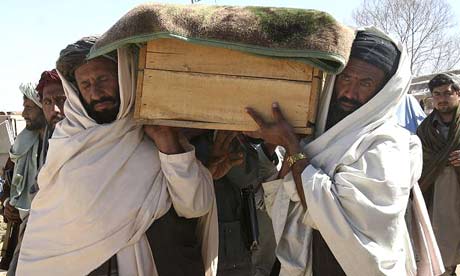
Afghan mourners carry a victim of last week's suicide bombing in Kandahar. Photograph: Allauddin Khan/AP

After six years of US-led military support and billions of pounds in aid, security in Afghanistan is "deteriorating" and President Hamid Karzai's government controls less than a third of the country, America's top intelligence official has admitted.

Mike McConnell testified in Washington that Karzai controls about 30% of Afghanistan and the Taliban 10%, and the remainder is under tribal control.

The Afghan government angrily denied the US director of national intelligence's assessment yesterday, insisting it controlled "over 360" of the country's 365 districts. "This is far from the facts and we completely deny it," said the defence ministry.

But the gloomy comments echoed even more strongly worded recent reports by thinktanks, including one headed by the former Nato commander General James Jones, which concluded that "urgent changes" were required now to "prevent Afghanistan becoming a failed state".

Although Nato forces have killed thousands of insurgents, including several commanders, an unrelenting drip of violence has eroded Karzai's grip in the provinces, providing fuel to critics who deride him as "the mayor of Kabul".

A suicide bomb at a dog fight near Kandahar last week killed more than 80 people. Yesterday fighting erupted in neighbouring Helmand when the Taliban ambushed a police patrol. The interior ministry said 25 militants were killed; a Taliban spokesman said they lost one.

A day earlier, the Asian Rural Life Development Foundation aid agency said it feared that Cyd Mizell, an American employee kidnapped in Kandahar last month, had been killed in captivity.

A big injection of foreign troops has failed to bring stability. The US has almost 50,000 soldiers in Afghanistan and - twice as many as in 2004 - while the UK has 7,700, mostly in Helmand. Another 2,200 US marines are due to arrive next month to combat an expected Taliban surge.

Nato commanders paint the suicide bombs and ambushes as signs of a disheartened enemy. Yesterday, Brigadier Andrew Mackay, commander of the British contingent in southern Afghanistan, said the Taliban were "worn down", running low on fighters, and being ostracised by local communities. "Logistically they are also challenged. The cumulative effect of all of this is that they are having to change their modus operandi, and that is why we are seeing more asymmetric attacks and suicide bombings in places such as Kandahar," he said.

But analysts believe the Taliban is successfully adapting the brutal guerrilla tactics that have served Iraqi insurgents so well. The six British soldiers killed in Helmand over the past three months were victims of roadside bombs. The drugs trade is swelling the Taliban coffers - according to the highest estimates, 40% of profits, or tens of millions of pounds, go to the insurgency. Attacks have made the main road from Kandahar to Kabul too dangerous for foreigners. Afghan truck drivers travel with armed escort.

The insecurity has penetrated the capital. Since an assault on Kabul's Serena Hotel last January, westerners have disappeared from the streets of Kabul. This week Taliban commanders threatened to step up the campaign with more bombs.

The key to the Taliban's success, McConnell said, "is the opportunity for safe haven in Pakistan". Meanwhile the surge in violence has placed a big strain on Nato. The French president, Nicolas Sarkozy, has agreed to deploy a battalion outside Kabul after America has criticised European states for refusing to join the fight in the south and Canada threatened to withdraw its troops from Kandahar next year if reinforcements do not arrive.

An Oxfam report yesterday said international and national security forces, as well as warlords, criminals and the Taliban, were perceived by ordinary Afghans as posing security threats.

Court gags ex-SAS man who made torture claims

A former SAS soldier was served with a high court order yesterday preventing him from making fresh disclosures about how hundreds of Iraqis and Afghans captured by British and American special forces were rendered to prisons where they faced torture.

Ben Griffin could be jailed if he makes further disclosures about how people seized by special forces were allegedly mistreated and ended up in secret prisons in breach of the Geneva conventions and international law. Griffin, 29, left the British army in 2005 after three months in Baghdad, saying he disagreed with the "illegal" tactics of US troops.

He told a press conference hosted by the Stop the War Coalition this week that individuals detained by SAS troops in a joint UK-US special forces taskforce had ended up in interrogation centres in Iraq and Afghanistan, as well as Guantánamo Bay. He had not witnessed torture himself but added: "I have no doubt in my mind that non-combatants I personally detained were handed over to the Americans and subsequently tortured."

Referring to the government's admission that two US rendition flights containing terror suspects had landed at the British territory of Diego Garcia, Griffin said the use of British territory and airspace "pales into insignificance in light of the fact that it has been British soldiers detaining the victims of extraordinary rendition in the first place".

The Ministry of Defence said it did not comment on special forces' activities.

In a separate move, the media have been prevented by a court order from reporting a court martial of six SAS soldiers charged with a conspiracy to "defraud of a value of about £3,000".

Bill Clinton: The Decline Of An Elitist Puppet


Steve Watson
Infowars.net
Thursday, Feb 28, 2008

In the vain of an emperor or dictator in his last days, Bill Clinton is losing his mind and lashing out. The past few months have seen him make bizarre comments, engage in biting skirmishes and with reporters and scuffles with rival politicians’ supporters, and react with intense venom to confrontations from 9/11 truthers.

The picture being painted is one of a former elitist sock puppet very publicly falling from grace.

Clinton’s actions have even led prominent democrats to fear he is damaging the party’s prospects.

Earlier this week Clinton gave a speech in which he actively encouraged those in attendance to "elect me", a telling slip of the tongue if ever there was one.

Prior to this he became involved in a scuffle with some Obama supporters in Ohio. “I think he even hit me in the face with his hand,” one man said. “He did give me a little pop."

Clinton has also made bizarre comments to reporters about Barak Obama orchestrating a "hit job" on him, without going into any details. Previously Clinton also caused a stir when he riled black voters by referring to Obama’s campaign as "the biggest fairy tale I’ve ever seen".

"Clinton’s damage-limitation exercise came after his wife also provoked controversy by appearing to diminish the achievements of Martin Luther King. She said it took President Lyndon B Johnson to implement the reforms that the assassinated civil rights leader had championed." reported the London Telegraph.

This Democratic commentator’s words sum up the decline of Clinton quite succinctly:

It is hard to watch. All of the political cache that this man has garnered since his Presidency is gone… he has this ‘anything to get elected’ quality that is destroying his relationship with the American people. I have been a fan of him in the past. I will be hard to woo back. In fact, I’m so dismayed at his behavior that I would have very little enthusiasm to support the campaign of his wife should she win the nomination. She could put the brakes on this train wreck. She won’t. This tag-team has been running rough shod over the opposition for a long time. But now, they are losing the fans.

With every sinister calculation and angry outburst, he acts like the administration that we are looking to oust. It is politics as usual. It is the logic of loyalty over competence. Make arguments that parse words and define the most simple terms, and attempt to confuse the people into believing that you are their friend. With twists and turns like that, it is a devilish combination.

Clinton’s most intense confrontations, however, have been with 9/11 truth protestors.

Clinton has had several run ins with members of We Are Change and other 9/11 truth groups who have consistently reminded Clinton that it was he who failed to pursue Osama Bin Laden despite having the opportunity to do so on several occasions.

Others have pointed out that the former National Security Advisor in the Clinton administration, Sandy Berger, was convicted of charges related to stealing/removing and destroying classified documents pertaining to pre-9/11 intelligence.

Questions and accusations also remain about the roles of Sandy Berger and the Clinton Administration at large of obfuscating the 9/11 Commission’s investigation (Bergers charges relate to this period).
http://en.wikipedia.org/wiki/Sandy_Be…

Despite this, Sandy Berger has now joined the Hillary Clinton campaign in an advisory capacity and would likely enter a Hillary Clinton administration.
http://www.examiner.com/a-977346~He_s…

In the face of these facts Clinton has the gall to stand up on his pedestal and call such protestors "people who are afraid of the truth", while his zombie-like fawning supporters close in on any dissenters like packs of wolves.


In a separate incident Clinton spouted "You wanna know what I think? You guys who think 9/11 was an inside job are crazy as hell. My wife was the senator from New York when that happened. I was down at Ground Zero. I saw the victims’ families. You’re nuts."

Here he fails to comprehend that some of the largest victims’ families groups continue to campaign for a new investigation, as well as justice for first dying responders, often working hand in hand with 9/11 truth groups.

On more than one occasion Clinton’s security entourage has detained and questioned protestors.

Other incidents:

Bill Clinton Shamed In Public Confrontation

Bill Clinton Takes On 9/11 Conspiracy Protesters

Bill Clinton has angry response for 9/11 heckler

Bill Clinton Confronted by WeAreChange.org

Bill Clinton Trades Blows With 9/11 Truthers

If you want a president who goes around calling people that disagree with him "nuts", giving them a little "pop in the face" and having them confronted by the secret service then the choice is clear, elect his wife.

Israeli War Minister Threatens Palestinian Holocaust


Paul Joseph Watson
Prison Planet
Friday, February 29th, 2008

Israel’s Deputy Defense Minister Matan Vilnai has provoked outrage after threatening Palestinians with a "holocaust," but the same media who obsessed about Mahmoud Ahmadinejad’s "wipe Israel off the map" misquote are scurrying to defend Vilnai’s disgraceful comments.

"The more Qassam (rocket) fire intensifies and the rockets reach a longer range, they (the Palestinians) will bring upon themselves a bigger holocaust because we will use all our might to defend ourselves," Vilnai told the Army Radio on Friday.

However, in a Reuters report, despite the fact that the rest of the statement was translated into English, the incendiary word "holocaust" remained in its original Hebrew version - "shoah".

Why Reuters would choose to print the rest of the statement in English yet cherry-pick one word to remain in Hebrew is obvious - they don’t want to draw any attention to the fact that Vilnai is threatening the Palestinians with a holocaust.

Vilnai’s spokesman has attempted to diffuse the controversy by claiming Vilnai was speaking in terms of a "disaster" and not a holocaust.

But you can’t have your cake and eat it.


Mahmoud Ahmadinejad


When Iranian President Mahmoud Ahmadinejad allegedly called for Israel to be "wiped off the map," the media blindly repeated the quote ad infinitum.


When Iranian President Mahmoud Ahmadinejad allegedly called for Israel to be "wiped off the map," the media blindly repeated the quote ad infinitum, and it became second nature for them to carelessly drop it into any propaganda piece intended to hype Iran’s supposed threat to Israel and the world.

Barely a day goes by that Israeli, American and British warhawks don’t spew the phrase like a broken record in an attempt to create a catchy cliché and brand market the next jaunt of imperial blood-letting.

No matter that, according to numerous different translations, Ahmadinejad never used the word "map," instead his statement was in the context of time and applied to the Zionist regime occupying Jerusalem. Ahmadinejad was expressing his future hope that the Zionist regime in Israel would fall, not that Iran was going to physically annex the country and its population.

To claim Ahmadinejad has issued a rallying cry to ethnically cleanse Israel is akin to saying that Churchill wanted to murder all Germans when he stated his desire to crush the Nazis. This is about the demise of a corrupt occupying power, not the deaths of millions of innocent people.

On the other hand, even as Reuters is forced to admit, Vilnai’s use of the word "shoah" is intrinsically allied to the context of "Discussions of the Nazi Holocaust of Jews," adding, "Many Israelis are loath to countenance its use to describe other contemporary events."

So will the media make reference to one of Israel’s top minister’s expressing his wish to inflict a Palestinian "holocaust" in all future reports about Israel’s geopolitical motives, just as they do with Ahmadinejad’s supposed call to wipe Israel off the map?

There’s more chance of Yasser Arafat and Menachem Begin coming back from the dead to broker a peace settlement.

Thursday, February 28, 2008

Iraq war 'caused slowdown in the US'

Peter Wilson
The Australian
Thursday, February 28, 2008

THE Iraq war has cost the US 50-60 times more than the Bush administration predicted and was a central cause of the sub-prime banking crisis threatening the world economy, according to Nobel Prize-winning economist Joseph Stiglitz.

The former World Bank vice-president yesterday said the war had, so far, cost the US something like $US3trillion ($3.3 trillion) compared with the $US50-$US60-billion predicted in 2003.

Australia also faced a real bill much greater than the $2.2billion in military spending reported last week by Australian Defence Force chief Angus Houston, Professor Stiglitz said, pointing to higher oil prices and other indirect costs of the wars.

Professor Stiglitz told the Chatham House think tank in London that the Bush White House was currently estimating the cost of the war at about $US500 billion, but that figure massively understated things such as the medical and welfare costs of US military servicemen.

The war was now the second-most expensive in US history after World War II and the second-longest after Vietnam, he said.

The spending on Iraq was a hidden cause of the current credit crunch because the US central bank responded to the massive financial drain of the war by flooding the American economy with cheap credit.

"The regulators were looking the other way and money was being lent to anybody this side of a life-support system," he said.

That led to a housing bubble and a consumption boom, and the fallout was plunging the US economy into recession and saddling the next US president with the biggest budget deficit in history, he said.

Professor Stiglitz, an academic at the Columbia Business School and a former economic adviser to president Bill Clinton, said a further $US500 billion was going to be spent on the fighting in the next two years and that could have been used more effectively to improve the security and quality of life of Americans and the rest of the world.

The money being spent on the war each week would be enough to wipe out illiteracy around the world, he said.

Just a few days' funding would be enough to provide health insurance for US children who were not covered, he said.

The public had been encouraged by the White House to ignore the costs of the war because of the belief that the war would somehow pay for itself or be paid for by Iraqi oil or US allies.

Full article here.

Lawyer Says Bin Laden Did Not Orchestrate 9/11 During Terror Trial


Paul Joseph Watson
Prison Planet
Thursday, February 28th, 2008

Skepticism towards the 9/11 official story reached the Australian Supreme Court this week after a lawyer asserted that the attacks were not orchestrated by Osama bin Laden during the trial of an alleged terror group in Melbourne.

"To say that this was all orchestrated by Osama bin Laden is a silly thing to do. He’s never claimed responsibility for it," Remy van de Wiel QC told the Australian jury.

Unless you accept the credibility of a dodgy videotape of a fat Bin Laden doppelganger "miraculously discovered" in a house in Jalalabad by U.S. troops and pushed as authentic by the ever-honest U.S. government, then van de Wiel has a point.

Indeed, Bin Laden’s first public statement following the 9/11 attacks was to deny any responsibility for carrying them out.

"I have already said that I am not involved in the 11 September attacks in the United States. As a Muslim, I try my best to avoid telling a lie. I had no knowledge of these attacks, nor do I consider the killing of innocent women, children and other humans as an appreciable act. Islam strictly forbids causing harm to innocent women, children and other people. Such a practice is forbidden even in the course of a battle," Bin Laden told the Pakistani-based Ummat newspaper.

Despite the fact that it only took three months to charge him with the 1998 embassy bombings, there has been no formal indictment of bin Laden over six years after 9/11 and the FBI’s wanted poster makes no reference of Bin Laden’s involvement in 9/11.

When asked by reporters why no reference was made, FBI agent Rex Tomb was forced to admit that "the FBI has no hard evidence connecting Bin Laden to 9/11."

Van de Wiel is the defense lawyer for Abdul Nacer Benbrika, leader of an alleged terror organization that the prosecution claims planned to carry out violent attacks in Australia.

Van de Wiel asserted that the group were incapable of organizing "a booze-up in a brewery," and pointed out the lack of evidence against them besides the fact that they liked to "bullshit to each other."

The case mirrors almost every other example we have studied in Britain, Canada and America , where a group of Muslims are infiltrated by security agents, radicalized and provocateured into saying something which could be perceived as advocating violence, and then arrested. Despite the complete lack of hard evidence of intent or capability to carry out attacks, the trials provide fodder for propagandists to cite in order to hoax the public into thinking terrorists are everywhere, thus convincing them to hand over more liberty in the name of security.

As we reported last week, four prosecutors In the Guantánamo Bay case assert that the trials are rigged and that convictions are already assured despite the fact that there is scant evidence to link Khalid Sheik Mohammed and his cohorts with 9/11, proving that the official story is a fable and the real perpetrators are being protected.

Bill Clinton Confronted in Austin

Youtube
Thursday, February 28, 2008


As mobs of people in the crowd shouted for the sign to be put down– and still others tore the 9/11 sign away– Clinton told the crowd, “It’s an honor to be heckled by people who are afraid of the truth.”

True doublespeak.

Part in parcel with the Clinton Administrations role in prior knowledge about Bin Laden’s operations as well as a looming attack…

Former National Security Advisor in the Clinton administration, Sandy Berger, was convicted of charges related to stealing/removing and destroying classified documents pertaining to pre-9/11 intelligence.

Questions and accusations also remain about the roles of Sandy Berger and the Clinton Administration at large of obfuscating the 9/11 Commission’s investigation (Bergers charges relate to this period).
http://en.wikipedia.org/wiki/Sandy_Be…

Despite this, Sandy Berger has now joined the Hillary Clinton campaign in an advisory capacity and would likely enter a Hillary Clinton administration.
http://www.examiner.com/a-977346~He_s…

U.N. Report: During Crisis, Eat Bugs

Sunday , February 24, 2008

AP

Crickets, caterpillars and grubs are high in protein and minerals and could be an important food source during droughts and other emergencies, according to scientists.

Photos: Mmm! Bugs for Dinner

"I definitely think they can assist," said German biologist V.B. Meyer-Rochow, who regularly eats insects and wore a T-shirt with a Harlequin longhorn beetle to a U.N.-sponsored conference this month on promoting bugs as a food source.

Three dozen scientists from 15 countries gathered in this northern Thailand city, home to several dozen restaurants serving insects and other bugs. Some of their proposals were more down to earth than others.

A Japanese scientist proposed bug farms on spacecraft to feed astronauts, noting that it would be more practical than raising cows or pigs. Australian, Dutch and American researchers said more restaurants are serving the critters in their countries.

The U.N. Food and Agriculture Organization estimates 1,400 species of insects and worms are eaten in almost 90 countries in Africa, Latin America and Asia. Researchers at the conference detailed how crickets and silk worms are eaten in Thailand, grubs and grasshoppers in Africa and ants in South America.

"In certain places with certain cultures with a certain level of acceptance, then insects can very well be seen as part of the solution" to hunger, said Patrick Durst, a Bangkok-based senior forestry officer at the FAO.

The challenge, experts said, is organizing unregulated, small bug food operations in many countries so they can supplement the food that aid agencies provide. The infrastructure to raise, transport and market bugs is almost nonexistent in most countries.

Prof. Arnold van Huis, a tropical entomologist known as "Mr. Edible Insect" in his native Netherlands, blamed a Western bias against eating insects for the failure of aid agencies to incorporate bugs into their mix.

"They are completely biased," van Huis said. "They really have to change. I would urge other donor organizations to take a different attitude toward this ... It's excellent food. It can be sustainable with precautions."

There are questions about the safety of eating bugs and potential dangers from over-harvesting them, said Durst, who became interested in the practice known scientifically as entomophagy during his years working in Bangkok, where crickets and bamboo worms are sold as food by street vendors.

Tina van den Briel, senior nutritionist at the World Food Program, the U.N. agency that provides food in emergencies, expressed doubt that insects can benefit large, vulnerable populations. Most bugs are seasonal and have a short shelf life, she said.

"They can be a very good complement to the diet," said van den Briel, not a conference participant. "But they do not lend themselves to programs like ours where you transport food over long distances and where you have to store food for a few months."

She suggested a more practical benefit might be adding insects to animal feed or crushing them into a meal powder that could be used to make cookies or cakes.

Meyer-Rochow said aid agencies might even find a way to harvest crop-destroying swarms of locusts and crickets.

"These mass outbreaks could be a valuable food source," he said. "If the technology is available, they could be ground up like a paste and added to the food humans eat."

Scarce Shoppers Sap Sears 4Q Profit

CHICAGO (AP) -- Department store chain Sears Holdings Corp. said its fourth-quarter profit tumbled 47 percent because of continued poor performance at its Kmart and U.S. Sears stores.

The Hoffman Estates-based company, controlled by financier Edward Lampert, said Thursday earnings dropped to $426 million, or $3.17 per share. That's down from $811 million, or $5.27 per share, during the same period last year.

Revenue slipped to $15.07 billion from $16.18 billion.

The performance was in line with Wall Street forecasts after the ailing company warned last month that eroding sales might push its profit down as much as 57 percent.

Excluding a one-time gain from the sale of some assets, Sears said it earned $3.04 during the quarter.

Analysts surveyed by Thomson Financial expected profit of $3.10 per share on higher revenue of $15.26 billion. Analyst forecasts typically exclude one-time items.

"Given the challenging retail environment, we will work to improve and tighten management of costs and inventory levels in 2008," said W. Bruce Johnson, Sears Holdings' interim CEO and president.

For the fiscal year, Sears suffered a similar slowdown, earning $826 million, or $5.70 per share. That's down more than 44 percent from the previous year's profit of $1.5 billion, or $9.58 per share.

Johnson, who took the helm of the company this month after president and chief executive Aylwin B. Lewis abruptly stepped down, also blamed the souring economy for the once-venerable retailer's trouble.

"Our fourth quarter and full year results continued to be negatively impacted by the worsening economic conditions faced by both our customers and competitors, as well as increased markdowns taken to clear excess inventory," he said in a statement.

Sears said it had about $1.6 billion in cash on hand - far less than the $3.8 billion the company had last year - as it continued to pour tens of millions into buying back stock.

Many investors have regarded Sears as a hedge fund masquerading as a retailer under Lampert, who acquired Kmart in 2003 and Sears, Roebuck and Co. in 2005. The company invests in foreign currency contracts as well as complex credit derivatives that are popular among hedge funds.

Investor confidence has appeared to melt away in recent weeks as Lampert's prospects of fixing Sears become more daunting.

In a note to investors Thursday, Lampert sought to silence critics as he defended his decision to buy back shares rather remodel stores that are showing their age.

"We know what it's like to be underestimated and questioned, but we intend to keep working on our game to achieve our full potential," he wrote.

Sears shares were unchanged in premarket trading.

Sprint Nextel Posts Wider $29.5B Loss

OVERLAND PARK, Kan. (AP) -- Sprint Nextel Corp. swung to a huge fourth-quarter loss of $29.5 billion on Thursday as it wrote down most of the remaining value of its 2005 purchase of Nextel Communications Inc. and continued to lose customers to competitors.

Chief Executive Officer Dan Hesse, who was hired in December to turn the nation's third largest wireless carrier around, said the quarter was more difficult than he had expected and it could be some time before proposed operational changes have any effect.

He also said that due to instability in the capital credit markets the company was borrowing from a revolving credit facility and was not declaring dividends for the "foreseeable future."

Sprint reported losing $29.5 billion, or $10.36 per share, during the quarter ending Dec. 31. By comparison, Sprint Nextel earned $261 million, or 9 cents per share, during the same period a year ago.

The company said last month it would likely have to write off most of the remaining $30.7 billion in goodwill value from the acquisition of Nextel and a number of affiliates. Sprint Nextel has struggled since the purchase, plagued by technical problems, unfocused marketing and a difficulty in merging the two companies' work forces into a cohesive whole.

Not including the write-down and other one-time charges, the company said it would have earned 21 cents per share before amortization, which was higher than the 18 cents per share expected by analysts surveyed by Thomson Financial.

Revenue during the quarter slipped 6 percent to $9.8 billion from $10.4 billion a year earlier, just missing analysts' expectations of $9.9 billion.

The company reported a net loss of 108,000 subscribers for the quarter as an increase in customers through its Boost prepaid brand and wholesale channels partially offset a loss of 683,000 subscribers who paid a monthly bill - considered the most valuable.

Sprint Nextel reported quarterly postpaid churn, or the measure of these monthly customers dropping service, remained level at 2.3 percent and the average revenue per user declined about 4 percent from a year ago to $58.

Sprint Nextel said overall wireless revenues declined about 6 percent to $8.5 billion.

"We plan to share some of our initiatives for improving the customer experience and operations next quarter," CEO Hesse said in a news release. "Strategic assessments and changes may take longer to complete."

Hesse, who replaced ousted CEO Gary Forsee, already announced last month that the company would lay off about 4,000 employees, or 6.7 percent of its work force, and close 125 retail locations. Earlier this month, he moved the company's corporate headquarters from Reston, Va., back to Kansas, which he said should improve efficiency and management oversight.

The company's shares have fallen more than 51 percent in value in the past year.

For the year, the company said it lost $29.6 billion, or $10.31 per share, compared with a profit of $1.3 billion, or 45 cents per share, in 2006.

Not including the goodwill writedown, the company said it earned 88 cents per share compared with $1.18 a year ago.

Annual revenue declined 2 percent to $40.15 billion.

Freddie Mac Posts Wider $2.5B Loss in 4Q

WASHINGTON (AP) -- Freddie Mac on Thursday said its loss widened to $2.5 billion in the fourth quarter of 2007 as defaults mounted on home mortgages and it set aside cash in expectation of further losses.

The fourth-quarter loss at Freddie Mac, the No. 2 U.S. buyer and backer of home loans, was larger than Wall Street expected and compares with a loss of $401 million in the last three months of 2006.

Freddie Mac reported the latest loss was equivalent to $3.97 a share versus a loss of 73 cents a share a year earlier and steeper than the loss of $2.34 per share that Wall Street analysts polled by Thomson Financial had expected.

Analysts on average had expected Freddie to report a $1.5 billion loss for the quarter.

The report followed by a day an earnings release by Fannie Mae, the larger government-sponsored sibling of Freddie Mac, showing a loss of nearly $3.6 billion in the October-December quarter. A federal regulator announced Wednesday that Fannie and Freddie will be allowed to expand their roles in the turbulent mortgage market, through the removal on March 1 of an investment-portfolio cap placed in the aftermath of multilbillion-dollar accounting scandals at the companies.

Analysts said the impact will be limited, however, because of the large cash cushion the companies must maintain as a reserve against risk.

McLean, Va.-based Freddie Mac's loss for all of 2007 was $3.1 billion, or $5.37 a share, compared with a profit of $2.3 billion, or $3 a share, in 2006.

Ron Paul: Bernanke Deliberately Destroying Dollar

Paul Joseph Watson
Prison Planet
Wednesday, February 27th, 2008


Congressman Ron Paul slammed Federal Reserve chairman Ben Bernanke during a House Financial Services Committee meeting today for following a policy of deliberately destroying the dollar and wiping out the American middle class.

Paul held Bernanke to task over his refusal to address the decline of the dollar and its clear link to inflation.

"Inflation comes from the unwise increase in the supply of money credit….to argue that we can continue to debase the currency, which is really the policy of that you’re following, purposely debasing value of currency - which to me seems so destructive….it just puts more pressure on the federal reserve to create capital out of thin air in order to stimulate the economy and usually that just goes into mal-investment," said Paul.

Paul highlighted the fact that the M3 money supply was rising at a rate of 16 per cent and that this was the real rate of inflation.

"History is against you," Paul told Bernanke, "History is on the side of hard money - if you look at stable prices you have to look at the only historic sound money that’s lasted more than a few years - fiat money always ends, gold is the only thing where you get stable prices," he added, pointing out that despite the price of oil’s rapid ascent, it had remained flat when compared to the price of gold.


"I cannot see how we can continue to accept the policy of deliberately destroying the value of money as an economic value," said Paul, adding that the policy was "immoral," and would lead to a reduction in American’s living standards and "the middle class being wiped out."

Asked how he could defend a policy of deliberately depreciating the dollar, Bernanke stumbled through his response and was basically forced to agree with Paul’s point.

Paul’s comments come on the day that the dollar hit its all time low against the Euro.

Earlier this week, former Fed chairman Alan Greenspan laid the groundwork for the further collapse of the greenback by encouraging Gulf states to abandon their dollar peg.

Investment Banker Predicts $300 a Barrel Oil

YouTube
February 27, 2008


CDC Recommends All U.S. Children Get Flu Shots

Reuters
February 27, 2008

Remember, according to "experts," mercury is good for your children (see video below), and a number of flu vaccinations still contain thermisol. If you don’t know this, chances are your kids will get a dose of this IQ-reducing neurotoxin.

WASHINGTON (Reuters) - All U.S. children aged from six months up to 18 should be immunized every year against influenza, a panel of federal vaccine advisers said on Wednesday.

The panel, which advises the U.S. Centers for Disease Control and Prevention on vaccine matters, agreed unanimously at its regular meeting in Atlanta that the new recommendations should go into effect as soon as possible, but no later than the 2009-2010 flu season.


The vote from the Advisory Committee on Immunization Practices would add about 30 million children to the list of those who should be vaccinated, CDC spokesman Curtis Allen said. The current recommendations cover children aged 6 months to 5 years old.

“There about 59 million (children aged 5 to 18) but a lot of those children are already covered under current recommendations,” Allen said in a telephone interview.

Based on current vaccination rates, the CDC predicts about 7 million additional children will be vaccinated because of the expanded recommendations.

Read entire article

****** Poster Comments**********

Stay away from those flue shots. Just run a google search for thermerasol mercury in vaccines, or Cancer viruses in vaccines, or God forbid Aids in the vaccines.

I have avoided vaccines for as long as I can remember. I don't ever take flue shots, and I never get the flue. People I know who do take the shots are sick more often than I am. Roll the dice and take your chances with the flue. Your childs odds are better with the flue than with those dirty vaccines.