Thursday, March 06, 2008

Bali Bomber Claims CIA/Mossad Involvement

Paul Joseph Watson
Prison Planet
Thursday, March 6, 2008


Initial reports said the Mitsubishi bomb consisted of C4, a military grade plastic explosive which is difficult to obtain, but the story was soon changed and the bomb was said to be of a more crude design. The sheer devastation the bomb wrought on surrounding buildings in the area suggested that a powerful explosive was used.

The ringleader of the Bali bombers claims that the attack on the nightclub district in 2002 was much larger than he had expected and that the only explanation for so much carnage was that the bombers were aided by the CIA, KGB or Mossad.

Imam Samudra, the alleged mastermind behind the attack who also chose the targets, told the London Times in an interview that the second explosion was bigger than the bombers had expected and the attack killed far more people than originally intended.

The death toll amounted to 202 people, 168 of whom were foreign nationals including 88 Australians and 28 Britons.

He claimed the bombers had never meant to kill so many people. What happened at Paddy’s Bar and the Sari Club was “unacceptable”, he said.

Had he made the bomb? “No, no, no!” he said, shaking his head. “I didn’t help to make it, and who made the bomb and when I don’t know.”

The second explosion was much bigger than they had expected, he said.

The only explanation, he suggested, was that “the CIA or KGB or Mossad” - those familiar bogeymen of the conspiracy theorist – had somehow tampered with the bomb. “It is very possible,” he claimed.

Despite The Times’ best efforts to scoff at the claim, the fact that U.S. and British authorities were tipped off in advance of the bombing is documented.

The second bomb, which was loaded inside a Mitsubishi L300 van, was detonated as people fled out into the streets as a result of the panic generated by the smaller first bomb which was detonated inside the nightclub.

Initial reports said the Mitsubishi bomb consisted of C4, a military grade plastic explosive which is difficult to obtain, but the story was soon changed and the bomb was said to be of a more crude design. The sheer devastation the bomb wrought on surrounding buildings in the area suggested that a powerful explosive was used.

Allegations of U.S. and British government prior knowledge and even involvement in the Bali bombing have repeatedly surfaced.

During an interview for an Australian documentary, former Indonesian President Abdurrahman Wahid unequivocally fingered the Indonesian authorities as the true culprits behind the October 2002 bombing. Wahid said the authorities were acting at the behest of Western intelligence agencies.

Indonesia has become renowned for rampant corruption and state involvement in terrorist atrocities. Sources told the film makers that government-connected criminals were carrying out an agenda of depopulation in the targeted areas by lowering the value of property and resources, then buying it on the cheap.

By following international news reports out of Taiwan at the time, we were able to confirm that the U.S. government had advance knowledge of the Bali bombing. They passed that knowledge on to the Taiwanese government and told them to keep the information top secret.

Hours before the bombing took place, the U.S. withdrew all its administrative staff and diplomats from Indonesia, citing a "security threat". The British government also received the same warning but this wasn’t passed on to any relevant authority or the hundreds of victims carelessly making their way to a beach party.

Immediately after the bombing, the FBI, the Australian Secret Service and British secret police swooped in to the bomb site and ruthlessly took charge of the investigation, much to the chagrin of the Indonesian authorities and the Balinese police.

The online documentary, The Truth About The Bali Bombings, explores some of these issues. Watch the four-part video below.


Small Explosion Rocks New York's Times Square

Military Recruiting Station Targeted; Minor Damage and no Injuries Reported

By RICHARD ESPOSITO

March 6, 2008 —

A small explosive device rocked New York's Times Square early today, causing minor damage to a military recruiting station.

The device shattered a glass entryway to the installation, but no one was injured, police said.

Law enforcement officials tell ABC News that a single, small improvised device was tossed, apparently by a man on a bike, at the armed forces booth in Times Square early this morning, causing the center of midtown Manhattan to be locked down and subways to be diverted but no major property damage.

Sources tell ABC News that the device was made from a green ammunition can filled with explosive powder. It blew out the lower part of the glass -- it's being described as a "low explosive."

Witnesses staying at a Times Square hotel in the area said they heard a "big bang" and could feel the building shake. A large plume of smoke was also visible after the explosion, they said.

Early in the investigation, subway cars passed through the Times Square station without stopping, but normal service was restored, with some delays, before the morning rush hour.

"If it is something that's directed toward American troops than t's something that's taken very seriously and is pretty unfortunate," Army Capt. Charlie Jaquillard, commander of Army recruiting in Manhattan, told The Associated Press.

The recruiting station, located on a traffic island surrounded by Broadway theaters and chain restaurants, has occasionally been the site of anti-war demonstrations, ranging from silent vigils to loud rallies.

The incident bore strong similarities to two past incidents where small homemade bombs or incendiary devices were tossed at official buildings in New York in the last two years. Two were tossed at the British consulate and more recently two were tossed at the Mexican consulate.

In each case a man on a bike was captured in hazy video images. In this case a man on a bike was seen leaving as well. Police found no second device this time.

Emergency service officers, bomb technicians and bomb sniffing dogs were combing the scene and collecting bits of metal that may have come from the device. They were packed with black power and detonated with fuses, but incapable of causing serious harm, police said.

In October 2005 a group of activists who call themselves the Granny Peace Brigade rallied there against the Iraq War. Eighteen activists, most of them grandmothers with several in their 80s and 90s, were later acquitted of disorderly conduct.

The recruiting station was renovated in 1999 to better fit into the flashy ambiance of Times Square, using neon tubing to give the glass and steel office a patriotic American flag motif.

For a half century, the station was the armed forces' busiest recruiting center. It has set national records for enlistment, averaging about 10,000 volunteers a year.

The Associated Press contributed to this report.

Wednesday, March 05, 2008

Fed: Economy Has Weakened

WASHINGTON (AP) — The economy has weakened since the start of this year as shoppers turned even more cautious given the severe housing slump and painful credit crunch.

Manufacturers and other businesses, meanwhile, had to cope with skyrocketing prices for energy and other raw materials. The businesses' ability to pass along higher prices to their customers was mixed, according to the Federal Reserve's new snapshot of nationwide economic conditions released Wednesday. Oil hit jumped to a record of $104.52 a barrel.

Many economists fear that the country is teetering on the edge of a recession or is in one already.

"Economic growth has slowed since the beginning of the year," the Fed reported. Two-thirds of the Fed's 12 regions "cited softening or weakening in the pace of business activity, while the others referred to subdued, slow or modest growth," the Fed said.

The report suggested that persisting problems in the housing market and harder-to-get credit are affecting the behavior of individuals and businesses alike — making them think twice about spending and investing.

Wall Street investors took the news in stride. The Dow Jones industrials gained 41.19 points.

The nation's retail sector is feeling the strain.

"Reports on retail spending were generally downbeat," the Fed said.

The Fed said that retailers in a majority of regions described sales as "below plan, downbeat, weak or having softened." Clothing sales, for instance, were reported as soft in the regions of New York and Philadelphia and Richmond, Va. Several regions noted declines in sales of "big ticket" goods and home-related items, the Fed said. Auto sales nationwide were characterized as slow or sluggish, the Fed said.

Spending by consumers accounts for a big chunk of overall economic activity and thus plays a major role in determining whether the economy will survive the housing and credit crises or fall victim to those problems.

Economic growth slowed to a near halt in the final three months of last year, advancing at a pace of just 0.6 percent. Many economists believe growth in the current January-to-March quarter will be worse — a pace of around 0.4 percent. Some analysts, however, believe the economy is shrinking now.

To help shore up things, the Federal Reserve has been cutting a key interest rate since September. As the economic situation continued to falter, the Fed turned much more aggressive. It slashed rates by 1.25 percentage points in the span of just eight days in January — the biggest one-month rate reduction in a quarter century.

Fed Chairman Ben Bernanke signaled last week that the central bank stands ready to lower rates again at its next meeting, March 18.

Some worry that the country could be headed for a bout of stagflation — a dangerous mix of stagnant economic activity and stubborn inflation. But Bernanke, in his congressional appearance last week, said he didn't believe that was the case.

The Fed's report said that companies had to deal with rising energy prices, which translated into increased transportation and shipping costs. Companies also reported price increases for metals, petrochemicals and food.

However, "firms ability to pass along cost increases by raising selling prices varied," the Fed said.

The Boston region, for instance, noted that retailers were passing "some price increases on to customers and some manufacturers were raising selling prices to partially offset rising costs." Half the manufacturers in the Cleveland region had raised prices or added surcharges since the Fed's last report in mid-January. The Dallas and Atlanta regions reported some companies raised their prices but others were constrained by competitive pressures. The Kansas City region said retail prices were "mostly stable." The Chicago region said businesses — other than construction and retail — were passing along cost increases to their customers.

On the manufacturing front, activity was reported to be sluggish or to have slowed in about half of the Fed's regions, the survey said. Some areas continued to cite weak demand for products and equipment used for building and furnishing homes. All Fed regions, however, expressed "caution or concern" about their near-term business prospects, the Fed said.

A separate report from the Commerce Department showed factory orders fell 2.5 percent in January, the biggest decline in five months. Another report from the Institute for Supply Management said activity in the service sector shrank in February.

The Fed's report, meanwhile, continued to paint a bleak picture of housing.

Most areas continued to suffer sagging home sales and home prices.

The one exception: the Manhattan co-op and condo market, where prices were up 5 percent compared with a year ago, the Fed said.

For commercial real estate, there were signs of slowing in the markets for office and retail space in some regions.

On the labor market front, there was some "loosening" or slowing in hiring, the Fed said. The regions of New York, Philadelphia, St. Louis and Atlanta reported an increased prevalence of layoffs, reduction in workers' hours or hiring freezes, the Fed said.

The government on Friday releases the employment report for February. Many economists are predicting the unemployment rate climbed to 5 percent from 4.9 percent.

The Fed's survey is based on information supplied by the Fed's 12 regional banks. The information was collected before Feb. 25.

FBI says subpoenas improperly used to obtain Americans' personal data

WASHINGTON (AP) - The FBI says it improperly used national security letters in 2006 to obtain personal data on Americans during terror and spy investigations.

But FBI director Robert Mueller (MUHL'-ur) tells the Senate Judiciary Committee that the privacy breach by FBI agents and lawyers occurred a year before the bureau implemented sweeping new reforms. He says the FBI is committed to maintaining the vital trust of the American people.

Details on the abuses are expected to come out this week in a report by the Justice Department's inspector general. It's a follow-up to an audit last year that found the FBI demanded personal data on people from banks, phone and Internet providers and credit bureaus without official authorization. It happened in non-emergency situations between 2003 and 2005.

Oil Rises Above $104 to Record on OPEC Output, Venezuela Tanks


March 5 (Bloomberg) -- Crude oil rose above $104 a barrel to a record in New York after OPEC gave no indication it will increase production, U.S. fuel inventories declined and Venezuela sent tanks to its border with Colombia.

The Organization of Petroleum Exporting Countries agreed to maintain production targets at a meeting today in Vienna. U.S. supplies fell for the first time in eight weeks, the Energy Department said. Venezuela activated the country's navy and air force in addition to 10 tank battalions being mobilized.

``Venezuela is sending troops to the Colombian border and everyone is a afraid that things will escalate,'' said Adam Sieminski, Deutsche Bank's chief energy economist in New York. ``Analogies with Kuwait in 1990 are being made. As if that's not bad enough, crude inventories fell more than 3 million barrels when they were supposed to rise.''

Crude oil for April delivery rose $4.89, or 4.9 percent, to $104.41 a barrel at the 2:30 p.m. close of floor trading on the New York Mercantile Exchange. Futures touched $104.64 a barrel, the highest since trading began in 1983. Prices are up 74 percent from a year ago.

Brent crude for April settlement rose $4.21, or 4.3 percent, to $101.73 a barrel on London's ICE Futures Europe exchange. Futures reached a record $102.29 a barrel on March 3.

On Oct. 15, prices passed the previous all-time inflation- adjusted record reached in 1981 when Iran cut oil exports. The cost of imported oil used by U.S. refiners averaged $39 a barrel in February 1981, according to the Energy Department, or $92.50 in today's dollars.

OPEC Concerns

``OPEC decided not to change production but there were comments that raised concerns, helping to push prices higher,'' said Rachel Ziemba an analyst of RGE Monitor, an online economic research company in New York. ``The OPEC communiqué and oil- minister statements raise the possibility that even if supplies aren't tight, that might not be the case in the future.''

Saudi Arabian Oil Minister Ali al-Naimi, who sets policy in the world's largest oil exporter, said earlier that supply and demand are stable. Naimi said that OPEC's aim was to keep stockpiles near the five-year average.

``While the OPEC agreement was expected, al-Naimi did say a couple things that are boosting the market,'' said Brad Samples, commodity analyst for Summit Energy Inc. in Louisville, Kentucky. ``He said OPEC doesn't want inventories to rise above the five- year average, which indicates they'll have to manage supply soon. Al-Naimi also said he doesn't sense that demand is weakening.''

U.S. crude-oil inventories in the week ended Feb. 22 were 7 percent above the five-year average for the period, the Energy Department said last week.

Bush Request

``I think it's a mistake to have your biggest customer's economy slowing down as a result of high energy prices,'' President George W. Bush said yesterday.

Gasoline for April delivery rose 10.91 cents, or 4.3 percent, to $2.6382 a gallon in New York. Futures touched $2.7325 on March 3, an intraday record for gasoline to be blended with ethanol, known as RBOB, which began trading in October 2005.

Venezuelan President Hugo Chavez on March 2 ordered the battalions to the border in response to a Colombian air raid against a guerrilla camp in Ecuador the day before. Venezuela and Ecuador are the only members of OPEC in the Western Hemisphere.

``I have long said you should watch what the Venezuelans do, not what they say; now they are doing something,'' said Robert Ebel, chairman of the energy program at the Center for Strategic and International Studies in Washington. ``I think this is more of a test of wills than anything but we have to keep an eye on the situation.''

U.S. Supplies

Crude-oil supplies fell 3.06 million barrels to 305.4 million in the week ended Feb. 29, according to the Energy Department. A 2.4-million-barrel gain was forecast, according to the median of responses by 15 analysts surveyed by Bloomberg News before the report's release.

``There's a significant reversal in sentiment about inventories,'' said Antoine Halff, head of energy research at New York-based Newedge USA LLC. ``The notion that the build in crude- oil stocks was inexorable is unraveling.''

Supplies of distillate fuels, a category that includes heating oil and diesel, fell 2.33 million barrels from 117.6 million barrels last week, the report showed.

Heating oil for April delivery rose 14.75 cents, or 5.3 percent, to $2.9393 a gallon. The contract touched $2.9466, the highest since trading began in 1978.

Crude-oil prices also rose because the dollar dropped to an all-time low against the euro, increasing the appeal of commodities as an alternative investment. The dollar touched $1.5303 per euro, the weakest since the euro's start in 1999, from $1.5217 yesterday.

Commodity Rush

``There's a continuing rush by investors into the commodity market,'' said Kyle Cooper, director of research at IAF Advisors in Houston. ``The rally isn't based on the fundamentals of the energy market.''

Gold and corn also rose to records today. Gold futures for April delivery climbed as much as 3 percent to $995.20 an ounce, the highest ever, on the Comex division of the Nymex.

Jobs needed or Iraq troop pullout at risk: U.S. general


TIKRIT, Iraq (Reuters) - The United States may be forced to halt planned troop withdrawals from Iraq unless Iraqi authorities move faster to create jobs and improve basic services, a top U.S. general said on Wednesday.

Major-General Mark Hertling, commander of U.S. forces in northern Iraq, said both central and regional authorities had to take action if hard-won security gains were not to be reversed.

"I think we have six months to make a difference and this today is the start line," he said in an interview with Reuters and another agency at a conference where governors from seven northern provinces aired grievances with government ministers.

Asked what would happen if no progress was made on improving Iraqis' quality of life, he said: "It's going to be harder.

"I'm going to see more soldiers hurt and killed and we are not going to be able to reduce the number of forces ... because there's going to be more people out there planting bombs and shooting people."

The governors of the northern provinces, some of which remain the most dangerous in Iraq, complained that the central government was failing to deliver on promises, particularly regarding the distribution of oil and power.

Deputy Prime Minister Barham Salih promised action but also said the governors had to take some responsibility themselves.

Troop levels in Iraq are a major political issue in the United States in a presidential election year. Democrats want a swift withdrawal while Republicans have said U.S. commanders should decide when it is safe to pull out.

Washington is cutting back the number of U.S. troops in Iraq after 30,000 extra soldiers were deployed last year to cut sectarian violence between Shi'ite and Sunni Muslims that took the country to the brink of civil war.

TROOP DRAWDOWN

General David Petraeus, the top U.S. general in Iraq, and U.S. Defense Secretary Robert Gates have said there should be a pause after a planned drawdown is completed this summer to assess the situation.

That would leave about 140,000 U.S. soldiers in Iraq.

U.S. ambassador to Baghdad Ryan Crocker said he could not put a time limit on how quickly steps needed to be made but agreed Iraqis needed to see action on jobs and services.

"Clearly they've got to make progress. That's what you've got to have to keep this from slipping back into further security problems," he told Reuters. He said he could not "hazard a prediction" on future troop levels.

U.S. and Iraqi officials pointed to Wednesday's conference in the northern city of Tikrit as a positive sign of progress.

A provincial powers law to define the roles of central and regional authorities was sent back to parliament last month by Iraq's three-member presidency council after being passed amid much fanfare just weeks before.

The law is regarded by Iraqi officials as a key step towards provincial elections, due to be held before October 1, which Washington hopes will help reconciliation.

Crimes by Homeland Security agents stir alert

JAY WEAVER AND ALFONSO CHARDY
Miami Herald
March 5, 2008

Bribery. Drug trafficking. Migrant smuggling.

A Customs and Border Protection officer at Fort Lauderdale-Hollywood International Airport was charged in February with conspiring to assist a New York drug ring under investigation by tapping into sensitive federal databases.

U.S. Customs and Border Protection is supposed to stop these types of crimes. Instead, so many of its officers have been charged with committing those crimes themselves that their boss in Washington recently issued an alert about the ''disturbing events'' and the ``increase in the number of employee arrests.''

Thomas S. Winkowski, assistant commissioner of field operations, wrote a memo to more than 20,000 officers nationwide noting that employees must behave professionally at all times -- even when not on the job.

''It is our responsibility to uphold the laws, not break the law,'' Winkowski wrote in the Nov. 16 memo obtained by The Miami Herald.

Winkowski's memo cites employee arrests involving domestic violence, DUI and drug possession. But court records show Customs officers and other Department of Homeland Security employees from South Florida to the Mexican border states have been charged with dozens of far more serious offenses.

Among them: A Customs and Border Protection officer at Fort Lauderdale-Hollywood International Airport was charged in February with conspiring to assist a New York drug ring under investigation by tapping into sensitive federal databases.

Winkowski, a former director of field operations in Miami, called the misconduct ''unacceptable.'' He told The Miami Herald that while he wrote the memo because of an uptick in employee arrests last fall, he didn't believe the problem was pervasive.

''Do I believe this is widespread in our organization? No, I do not,'' he said in an interview Tuesday. ``Are there examples where we fall short? Yes.''

Two highly controversial issues, illegal immigration and national security, have thrust the Department of Homeland Security into the public eye as it labors to prevent another terrorist attack in the post-9/11 era.

The bureaucratic behemoth grew out of a controversial consolidation five years ago of several agencies, including the U.S. Customs Service and Immigration and Naturalization Service.

Employees of both joined either Customs and Border Protection or Immigration and Customs Enforcement, known for their acronyms CBP and ICE.

CBP handles the border, airports and seaports, while ICE investigates immigration and customs law violators.

''We as an agency are constantly policing ourselves so that the public trust is not diminished as a result of inappropriate activity, whether it's on the job, off the job, criminal or not criminal,'' said Zachary Mann, a special agent and spokesman for Customs and Border Protection in Miami.

Some Immigration and Customs Enforcement employees also have been caught up in episodes of alleged misconduct. But Anthony Mangione, the special agent in charge of Immigration and Customs Enforcement in Miami, said he was not aware of any increase in criminal or administrative actions ``even though we have had a substantial increase in personnel since the merger.''

UNDER WRAPS

Federal authorities normally keep administrative incidents quiet. But officials cannot control publicity in the event of serious criminal behavior, like the February case involving the Border Protection officer at Fort Lauderdale-Hollywood International Airport.

Elizabeth Moran-Toala, a six-year veteran, allegedly accessed an electronic database known as Treasury Enforcement Communications System, a tool to stop illegal drug imports.

According to an indictment, she is accused of tapping into the system several times to pass along information to a Delta Airlines baggage handler who was conspiring with a drug ring to transport cocaine and heroin from the Dominican Republic to New York. Moran-Toala, 36, was transferred to New York in February for prosecution.

Other recent South Florida cases -- mirroring a pattern along border states -- have involved officers and agents accepting payoffs for migrant smuggling, drug trafficking, witness tampering, embezzlement and rape.

Agency managers say these cases reflect individual criminal behavior, not the culture of the agencies.

But some longtime employees said administrative incidents, like hostile confrontations or heavy drinking, may reflect the low morale and intense rivalries following the merger of federal agencies under Homeland Security.

Some employees from the old Immigration and Naturalization Service are the most vocal in their complaints. They bitterly denounce employees who came from the old Customs Service for ''seizing control'' of both CBP and ICE, ''lording it over'' former INS employees and showing disdain toward immigration-related work.

Expected to improve efficiency, the merger has instead spawned tension. Both Border Protection and Customs Enforcement scored near the bottom in a 2007 survey of employee satisfaction at 222 federal government agencies.

''It's become a cultural clash, tensions between officers from the merged agencies,'' said a Customs and Border Protection officer who asked not to be identified because he did not have authorization to speak publicly. ``There's low morale and tension. Some people drink; others take it out on their colleagues or supervisors. It's no fun anymore.''

Mangione dismissed the notion that employee misbehavior is a result of post-merger friction. ``It's somebody being a criminal.''

Mangione, who came from Customs, noted Gabriel Garcia, second-in-command in the Miami Immigration and Customs Enforcement office, came from INS.

ATTACK AT PARTY

The tension may have been a factor in a Jan. 11 brawl between two ICE employees at a Broward police association hall. During a retirement party, an ICE supervisor with a Customs background allegedly attacked an ICE agent with an INS background.

According to an internal document on the episode obtained by The Miami Herald, ICE group supervisor Mack Strong assaulted ICE senior special agent Francisco Meneses at the party.

The altercation began when Strong used profanity to refer to another officer, also from INS, and Meneses asked Strong not to use such an expletive.

''Strong came at me again, grabbing me and throwing me down to the floor, where he continued to physically strike me with his fists,'' Meneses wrote in a memo that went to Mangione.

Neither Meneses nor Strong wanted to speak on the record.

Mangione said the case is being investigated: `` It was turned over to the Office of Professional Responsibility and there it lies.''

Clinton Hints At Sharing Ticket With Obama

Speaking on the Early Show on CBS, Clinton said “that may be where this is headed, but we have to decide who is on the top of the ticket.”

WCBSTV 2
March 5, 2008

NEW YORK (CBS) ― Sen. Hillary Rodham Clinton hinted at the possibility of a democratic “dream ticket” with Sen. Barack Obama.

Speaking on the Early Show on CBS, Clinton said “that may be where this is headed, but we have to decide who is on the top of the ticket.”

Clinton said the race between her and Obama remains “incredibly close,” with just “smidgens of difference” between them.

Clinton’s remarks after her campaign won two big states yesterday: Ohio and Texas. She also won Rhode Island. The wins enabled her campaign to break Obama’s 12-state winning streak and pick up some momentum of its own.

Read entire article

Threat of war as Venezuela and Ecuador order troops to Colombian border

Rory Carroll and Sibylla Brodzinsky
The Guardian
March 5, 2008


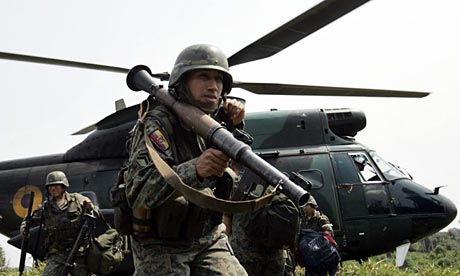
Ecuadorean soldiers arrive at Angostura.

Ecuadorean soldiers arrive at Angostura, next to the Colombian border, in Ecuador. Photograph: Dolores Ochoa/AP

Venezuelan and Ecuadorean troops deployed on Colombia's frontier last night as South America's military and diplomatic crisis escalated into a dangerous showdown between President Hugo Chávez and Colombia's US-backed government.

Venezuela started shutting crossing points on the 1,400-mile border to try to isolate its neighbour after Bogotá made a series of extraordinary allegations about the Venezuelan leader funding Marxist guerrillas intent on building a uranium-enriched "dirty" bomb.

"Colombia proposes to denounce Hugo Chávez, president of Venezuela, in the international criminal court for sponsoring and financing genocide," said President Alvaro Uribe.

The Organisation of American States, a pan-regional body, held an emergency meeting in Washington to seek a diplomatic solution after President George Bush sided with Colombia, his administration's key ally in Latin America. The US president accused Venezuela of "provocative manoeuvres" and said he stood by Bogotá and its fight against terrorism. He also urged Congress to approve a free-trade agreement with Colombia.

Pictures of Venezuelan trucks and tanks rolling west, the vanguard of 10 battalions which were ordered to mobilise, and of Ecuadorean troops moving to the Colombian frontier from the other side of the Andes, underlined the risk of South America enduring its first war in over a decade. Quito and Caracas have severed diplomatic ties with their neighbour.

"A serious cross-border military conflict is unlikely [but] the chain of actions and reactions often has a life of its own. There is no telling where it could lead," said Michael Shifter, of the Inter-American Dialogue thinktank.

Colombia triggered the crisis last Saturday by bombing a rebel camp one mile inside Ecuador, killing at least 21 members of the Revolutionary Armed Forces of Colombia (Farc), including a senior commander, Raul Reyes.

The Marxist group, which has been waging an insurgency against the Colombian state for decades, said yesterday the raid gravely damaged chances of further releases of some of the 700 hostages it holds in jungle camps, including Ingrid Betancourt, the ailing Franco-Colombian politician who has become the public face of the captives' plight.

The rebels said in a communique that Reyes died completing a mission to arrange Betancourt's release through Chávez and the French president, Nicolas Sarkozy, who has made it a personal cause. Sarkozy said last week that Betancourt could be near death, and that her "martyrdom is the martyrdom of France".

Bogotá said it would not match its neighbours' border deployments but it ratcheted up tension by making explosive claims based on information allegedly culled from Reyes' laptops, an intelligence treasure trove which some called the "brain" of the insurgency.

The Colombian government said Chávez received money from the drug-funded guerrillas in 1992 when he was an impoverished coup-monger with political ambitions and that recently, now a self-styled socialist revolutionary at the helm of an oil power, he gave the rebels $300m.

The Venezuelan's leftwing affinity with the Farc is no secret but if the allegation is substantiated he could in theory be prosecuted since internationally the Farc are categorised as terrorists. Bogotá would probably first have to go through Colombian courts so there is little immediate chance of The Hague summoning Chávez. A Venezuelan government minister said the allegation was a smear.

Colombia's vice president, Francisco Santos, dropped another bombshell at a UN disarmament meeting in Geneva when he said the laptops also revealed the guerrillas were negotiating to obtain radioactive material. "This shows that these terrorist groups, supported by the economic power provided by drug trafficking, constitute a grave threat not just to our country but to the entire Andean region and Latin America."

He provided no corroboration, prompting some scepticism that Bogotá may be making extravagant claims to deflect the chorus of criticism from Latin America and Europe over its raid into Ecuador, a territorial violation for which it has apologised to Quito.

Ecuador's justice minister, Gustavo Jalkh, also in Geneva for a UN meeting, said Colombia had violated human rights obligations. "The international community will know that it must close ranks." Efforts to cast Colombia as a military bully and the Israel of South America seemed to resonate with Brazil and Chile, among others, issuing sharp rebukes to Bogotá for its incursion.

The invocation of dirty bombs and state-sponsored terrorism fuelled a febrile atmosphere which at times verged on comic opera. An unrelated taxi strike on a motorway reportedly bogged down Venezuelan military convoys and some vocal government supporters in red T-shirts vowed to mobilise neighbourhood militias, a chavista version of neighbourhood watch.

Otherwise there was little sign of martial mood. Daily life largely continued as normal across Ecuador, Colombia and Venezuela. Caracas's skittish middle class, which habitually stocks up on tinned food and toilet paper at the first sign of political turmoil, had yet to make a run on the supermarkets.

In Bogotá the mood went from celebratory to sombre in just a few short days. Saturday's strike against the Farc was popular but by yesterday the focus was on the border tensions. "Before, it [a war] seemed like something far off and impossible. Now it looks like it's something that's possible and very, very close," said one Bogotá resident, Javier Cardenas, 30.

Despite a recent arms build-up Venezuela's army is puny compared to the US-equipped, war-seasoned Colombian armed forces. Another deterrent to hostilities breaking out is cross-border trade worth $6bn annually, much of it Colombian food imports on which Venezuela depends.

"The good news is that the three countries are so intertwined that a military conflagration would be tremendously costly for all," said Shifter.

Investigation Launched Into Vote Stealing in Texas

Stephen Dean
Click2Houston.com
March 5, 2008

HOUSTON — Voters reported being turned away from the polls, prompting a criminal investigation into vote stealing, Local 2 Investigates reported Tuesday.

The Harris County District Attorney’s Office confirmed it is contacting the victims, all centered around Precinct 219 in southeast Houston.

“I feel really hurt,” said Garland Boone, a voter in the Third Ward neighborhood off Yellowstone, where the scam was reported.

He said his neighbors who are victims “don’t have a chance to express their vote. Everybody needs to express their own vote.”

Precinct Judge Edna Russell told Local 2 Investigates that some senior citizen voters had to be turned away because absentee ballots had already been mailed in using their names.

“Somebody had already voted for me,” said Georgia Ireland.

She and the other victims reported that people were going door-to-door, offering help to seniors with filing voter registration forms.

Some victims signed the paperwork, while others did not, but the scammers then used the information to mail absentee ballots in their names, meaning their votes were stolen from them.

“I thought that was horrible,” Ireland said. “I really wanted to know how they could do that (because) I never signed nothing. Not a thing.”

Witnesses inside the voting location at Mount Olive Baptist Church said some of the victims cried and others yelled, “This is how they’re going to steal the election from (Presidential candidate Barrack) Obama.”

Read entire article

Pentagon to test invisible gases in Crystal City

WASHINGTON (Map, News) - The Pentagon is scheduled to release an odorless, invisible, and yes, harmless, gases into the city Thursday to test how quickly they spread through buildings, officials said.

The test is part of the military's national security preparation for the capital area.

Over the past few years, the defense agency has worked with Arlington County to set up chemical sensors throughout the county, where thousands of defense employees work in leased office space.

The Pentagon has also supplied the sensors and accompanying monitoring equipment to Arlington for the county's own use.

"Within minutes, if someone attacks the Pentagon, it becomes a problem for Arlington," Pengtagon Force Protection Agency Director Paul Benda said.

The sensors scan broad areas, Benda said.

If weather cooperates, the Pentagon will release perfluorocarbon tracers, which are commonly used commercially to detect leaks, and sulfur hexafluoride, a common window insulator filling, near the Jefferson Plaza building at 10am on Thursday and Friday.

Officials in yellow vests will set up 80 battery-operated samplers - toolbox-looking cases with 12 air tubes inside of them - throughout Crystal City and will check the air samples in the tubes afterwards to evaluate how quickly and how high the gases spread.

The data will help the Pentagon and Arlington shape their lockdown policies for chemical and biological attacks or accidents, and will also help them determine the most effective locations for sensors.

"We want to place our sensors so we can detect this stuff as quickly as possible," Benda said.

The test, dubbed "Urban Shield: Crystal City Urban Transport Study," is similar to one conducted in Manhattan a few years ago, officials said.

Vermont towns vote to arrest Bush and Cheney

WASHINGTON (Reuters) - Voters in two Vermont towns on Tuesday approved a measure that would instruct police to arrest President George W. Bush and Vice President Dick Cheney for "crimes against our Constitution," local media reported.

The nonbinding, symbolic measure, passed in Brattleboro and Marlboro in a state known for taking liberal positions on national issues, instructs town police to "extradite them to other authorities that may reasonably contend to prosecute them."

Vermont, home to maple syrup and picture-postcard views, is known for its liberal politics.

State lawmakers have passed nonbinding resolutions to end the war in Iraq and impeach Bush and Cheney, and several towns have also passed resolutions of impeachment. None of them have caught on in Washington.

Bush has never visited the state as president, though he has spent vacations at his family compound in nearby Maine.

Roughly 12,000 people live in Brattleboro, located on the Connecticut River in the state's southeastern corner. Nearby Marlboro has a population of roughly 1,000.

Tuesday, March 04, 2008

CNN Warns Americans A New Great Depression Is Coming

Darryl Mason
Tuesday, March 4, 2008


The American economy is propped up on faith and credit, and Wall Street is now in a short supply of both of these essentials. The video below from CNN Money contains the sort of talk that can start runs on banks to withdraw savings and shatter stock markets. That doesn't mean, however, these commentators are not telling the truth.


History will likely record that the "$3-8 Trillion" Iraq War was a key reason why the American economy shuddered to a stop and a new Great Depression began, if the financial genocide continues :

The spending on Iraq was a hidden cause of the current credit crunch because the US central bank responded to the massive financial drain of the war by flooding the American economy with cheap credit.

"The regulators were looking the other way and money was being lent to anybody this side of a life-support system..."

That led to a housing bubble and a consumption boom, and the fallout was plunging the US economy into recession...

Iraq: Theater of the Macabre

Kurt Nimmo
Infowars
March 4, 2008

In response to Alex’s call for videos demonstrating the psychopathology and sadism of “our troops” in Iraq following the breaking story of David Motari, the alleged Marine puppy killer, listeners have responded on the Prison Planet Forum with a virtual theater macabre of sickness and deranged perversity.

Please note: it is extremely difficult for us to post these videos and we do not do so out of any morbid fascination with murder, torture, and humiliation, but rather as an example of the sort of behavior “our troops” engage in as they go about undertaking the criminal dirty work of the hell spawn neocons. Considering the almost complete lack of coverage of these disgusting events in the corporate media, we feel compelled to post these videos.

Remember, a large percentage of Iraqi veterans end up working for police departments when they finish their “tours” in Iraq — multiple back-to-back tours, obviously to indoctrinate them in sadism and the techniques of inhumanity — and will be used against the American people during the next “emergency” when the reigning decider-commander — Bush, Obama, or Hillary — will impose martial law.

—


These icons link to social bookmarking sites where readers can share and discover new web pages.
  • Digg
  • Reddit
  • del.icio.us
  • NewsVine
  • Technorati
  • SphereIt
  • StumbleUpon
  • Fark

David Motari, Alleged Puppy Killer, Tracked Down

Kurt Nimmo
Infowars

March 4, 2008


Gold


It didn’t take long for internet sleuths to track down the perp. David Motari, the Marine accused of pitching a puppy off a cliff for the sheer psychopathic fun of it, is a member of the Bebo social network. Although the network requires registration to view member profiles, an enterprising researcher was able to login and screen capture Motari’s profile (click small image at left to see a larger image).

Motari is a Lance corporal, 1st Battalion, 3rd Marine Regiment, stationed at Haqlaniyah, Iraq, and based out of the Marine Corps Base at Kaneohe, Hawaii. He is from Seattle, Washington.

“Don’t have to follow nobodies (sic) footsteps,” writes the Marine on his Bebo profile. “I’m makin my own, fully grown, and this life is my own.” Motari tells us he is “happiest when… Chillin out, sleeping, playing sport, hittin the gym, hangin with friends, with my family, at home, fridays, eating, running, cruisin, and defintely (sic) when I get out of the marine corps!” He forgot to add he is especially happy when emulating Jeffrey Dahmer, who also shared a penchant for torturing and killing small defenseless animals.

“There is no way to know for sure if the puppy is real or not unless you are the one who produced it,” explains Charlie Powell, College of Veterinary Medicine, Washington State University.

However, after watching the video on YouTube, it certainly appears the puppy was alive prior to Motari’s sadistic stunt.

Bernanke sees more house price drops

ORLANDO, Florida (Reuters) - Federal Reserve Chairman Ben Bernanke on Tuesday warned mortgage delinquencies and foreclosures were likely to rise and that more house price declines could be expected, and called for active measures to stabilize housing markets.

"This situation calls for a vigorous response," Bernanke said in a speech to the Independent Community Bankers of America, referring to government and private-sector initiatives to slow the rate of home loan failures.

"Measures to reduce preventable foreclosures could help not only stressed borrowers but also their communities and, indeed, the broader economy," he said.

Current housing difficulties differ from past housing market slumps because of the large number of homeowners who owe more on their home loans than their homes are worth, Bernanke said.

"In this environment, principal reductions that restore some equity for the homeowner may be a relatively more effective means of avoiding delinquency and foreclosure" than reducing interest rates on troubled home loans, he said.

Face up to losses, Bernanke tells bankers

WASHINGTON (MarketWatch) -- Rather than cling to the illusion that they'll get repaid in full, banks should face up to their losses from all those bad mortgages they underwrote, Federal Reserve Chairman Ben Bernanke told bankers Tuesday.

It's time to take the losses onto the books, so they and the rest of the economy can move on, he said.

All the debt counseling, foreclosure freezing, HOPE alliancing, and interest-rate reducing haven't made a dent in the problem yet. So far, he said, you haven't done nothing.

Bernanke's remarks were the clearest sign yet that he's beginning to understand the full extent of the mess the banks made.

"This situation calls for a vigorous response," Bernanke said in a speech to the Independent Community Bankers of America. The only way to avoid millions of foreclosures is to figure out how to reduce the principal amount the homeowner owes.

In other words, face up to the fact that home prices have plunged and won't go back to lofty levels for a long, long time.

Because foreclosure is so expensive (taking 50% of the principal in legal fees, missed payments and other expenses), it probably makes more sense (and dollars) for the lender to simply write down the value of the mortgage to what the home is actually worth on the market. Writing down the principal would allow the borrower to refinance into an affordable mortgage in many cases.
That would keep many families in their home, and help housing prices adjust.

Bernanke's idea is simple in theory but terribly complex in practice. Because most of these mortgages have been securitized, writing down the principal could require the agreement of dozens, or hundreds, or even thousands of "owners."

But Bernanke was optimistic that the brilliant minds who cooked up the complicated financial instruments that got us into this problem can also figure a way to get us out.

And if they can't, maybe it's time for more "vigorous" action from someone who can.

Smiling US Marine throws puppy off Iraq hill

By Bonnie Malkin

Last Updated: 12:30pm GMT 04/03/2008

The American army is investigating shocking footage of a grinning Marine throwing a yelping puppy into a gully in Iraq.

The clip, which has prompted fierce criticism of the military, appeared on video sharing site YouTube.

It showed two Marines dressed in combat gear, one holding the young dog by the scruff of its neck.

The dog, which looks about eight weeks old, is motionless.

"Cute little puppy, huh?", one Marine can be heard saying.

"Oh so cute, so cute little puppy," the other responds in a child-like voice.

The Marine holding the dog then turns and throws it into the ravine below. The animal can be heard yelping until it hits the ground.

A spokesman for the American military condemned the video as "shocking and deplorable" and said an investigation was underway into the incident.

Marine spokesman Major Chris Perrine said the culprit was believed to be based in Hawaii.

"We do not tolerate this type of behaviour and will take appropriate action," he said.

(( This video is being removed from Youtube with quickness, since this appeared in the controlled mainstream media. If its unavailable. Just go to Youtube. Search "Marine Puppy" and sort by date. As its taken down, we will add it again. This is going to be seen. ))

US seeks terrorists in web worlds

By Chris Vallance
Reporter, BBC iPM

The US government has begun a project to develop ways to spot terrorists who are using virtual worlds.

Codenamed Reynard it aims to recognise "normal" behaviour in online worlds and home in on anomalous activity.

It is likely to develop tools and techniques for intelligence officers who are hunting terrorists and terror groups on the net or in virtual worlds.

The project was welcomed by experts tracking terror groups using the net to organise or carry out attacks.

Growing threat

Brief details about Reynard came to light in a report sent to the US Congress by the Office of the Director of National Intelligence (ODNI) - which co-ordinates the work of US intelligence agencies.


We can see groups emerging in cyber spaces and virtual communities that would be wholly virtual
Roderick Jones, Concentric Solutions
In that report, which talked about the data mining efforts undertaken by the ODNI, Reynard was described as: "a seedling effort to study the emerging phenomenon of social (particularly terrorist) dynamics in virtual worlds and large-scale online games and their implications for the intelligence community".

Using publicly available data Reynard researchers will carry out observational studies to establish "baseline normative behaviors".

Once these are identified, Reynard will "then apply the lessons learned to determine the feasibility of automatically detecting suspicious behavior and actions in the virtual world".

"It's a positive step," said Andrew Cochran, founder and co-chairman of the Counterterrorism Foundation. "For a number of years we were behind in chasing jihadists' presence on the net and detecting it."

"That's a very sensible step at the moment," said Roderick Jones, a vice president of Concentric Solutions and a former special branch officer. "Just to feel their way around them and work out what new intelligence collection methods might be required to deal with this threat, because you won't be able to use traditional law enforcement methods."

New worlds

A senior intelligence officer at the ODNI said Reynard was in its very early stages and it was too soon to say which online worlds it would be studying. He added that any work on it would be purely for research rather than "operational" purposes.

"I think its highly unlikely terrorists would use things like Second Life or World of Warcraft as they do not have the necessary security," said Mr Jones.

"Terrorist use of the internet at the moment relies on password protected forums," he added.

Said Mr Cochran: "All of the major terrorist treatises have been distributed through the internet so taking it to a virtual world with multi-player role games is really an easy step."

It was inevitable that terror groups would make greater use of the internet and the possibilities that virtual spaces offered them, said Mr Jones.

"There's more a chance of things like Jihad worlds coming online in the next five years I think," he said.

The visual richness of virtual worlds made them good places to educate recruits about techniques, said Mr Jones.

Attack pattern

"We can see groups emerging in cyber spaces and virtual communities that would be wholly virtual," he said. "They would organise and radicalise in virtual worlds and attack using cyber methods without becoming a real world presence in any real way."

Many groups were likely to use the expertise and skills they learn in virtual worlds to target key net systems.

Ken Silva, chief technology officer for Verisign which oversees some of the net's core address books, said such an attack could be "devastating".

"We see a continuing growth in the amount of horsepower in the attacks that are directed at infrastructure servers," said Mr Silva.

"We are seeing a large shift from attacks that are directed at individual websites," he said. "The sophistication is getting a little smarter and they are attacking the infrastructure pieces behind them..., which is typically in most production environments the least invested in."

Some of the basic systems of the net, such as the Border Gateway Protocol (BGP) which helps data reach its intended destination, were open to attack.

An accidental misconfiguration of BGP in some routers in Pakistan caused the recent problems with YouTube which left many people unable to reach the video site.

"BGP is essentially a relatively unprotected protocol and is seriously vulnerable to disruption," he said. "Should that happen, it could take a very long time to correct that situation."

"This has to be fought at every level," he said.

Story from BBC NEWS:
http://news.bbc.co.uk/go/pr/fr/-/2/hi/technology/7274377.stm

Published: 2008/03/03 11:32:50 GMT

Barclays 'questioned over terrorist blacklist'

By Katherine Griffiths, Financial Services Editor

Last Updated: 7:30am GMT 04/03/2008

Barclays is being investigated by the US government over possible breaches of rules banning banks from doing business with states on a terrorist blacklist.

The bank said it had been contacted by the Department of Justice (DoJ) and the New York district attorney with questions about payments made in dollars through its New York branch. The payments may have been made by people or companies from states which are on the US blacklist of nations it believes sponsor terrorism. That list includes Cuba, Iran, North Korea, Sudan and Syria.

The US has banned banks from carrying out most transactions in dollars for clients from these countries to try to undermine terrorists' ability to finance their activity.

The probe, which has gone unnoticed until now, was referred to in Barclays' notes to its annual 2007 results on February 19, where it warned "the potential financial effect of any resolution could be substantial".

In the past few years US banks have had to obey the rules, which carry heavy penalties and potential criminal prosecution. America is now putting increasing pressure on European banks to follow.

ABN Amro was fined $80m (£40m) in civil penalties in 2005 for transactions through its New York offices which the US government said failed to meet the necessary controls on money laundering.

The case dealt a serious blow to the credibility of the Dutch bank. ABN was sold following a bidding battle to a consortium led by Royal Bank of Scotland in October.

RBS said in its annual results published last week that ABN is the subject of an ongoing criminal probe by the DoJ over the same issue. Negotiations over a possible $500m settlement are ongoing, RBS said.

HSBC yesterday noted in its results that it has a "small representative office in Tehran". HSBC said it recognised that should it break the US rules on sanctions, there would be "serious legal and reputational consequences".

America's Office of Foreign Assets Control (OFAC) polices companies to ensure sanctions are upheld.

Certain foreign institutions are completely banned from making dollar payments, while in other cases "U-turn" transactions are permitted, whereby a dollar payment is legal as long as it does not start or end in the suspect country.

European banks such as Barclays and RBS must follow US policies because they have large businesses there.

Ellen Zimiles, chief executive of Daylight, which advises companies on compliance with OFAC and other laws, said: " Non US institutions which operate in the US have to make sure their people have proper training and understand what the issues are."

Barclays said it was carrying out its own internal review. It said the outcome was unlikely to have "a material adverse effect" on its finances.

Separately, Barclays said it was buying Russian lender Expobank for £373m in its first overseas acquisition since losing the bidding contest for ABN. The deal expands the empire of Frits Seegers, head of Barclays' retail and commercial banking business.

Expobank, with one of the largest networks of cash machines in Moscow, has net assets of £93m.